
Cannas
Cannas add lush color and texture to any Florida garden, thanks to their beautiful flowers and interesting leaves.

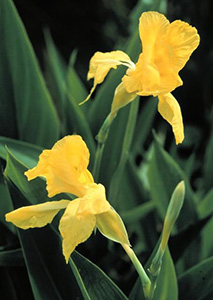
Cannas are tropical “bulbs” (to be specific, rhizomes) with large, colorful lily-like flowers and upright spear-shaped foliage. Wild types like golden canna thrive in boggy areas and ponds, while popular commercial cultivars like ‘Black Knight’, ‘Pretoria’, ‘Tropicanna’™, ‘Wyoming’ and others will grow in most gardens if given adequate care.
Gardeners looking for specific cultivars should know that some are sold under multiple names. For example, ‘Tropicanna’ is also known as ‘Durban’ and ‘Phaison’, while ‘Pretoria’ is also known as ‘Bengal Tiger’, ‘Malawiensis Variegata’ and ‘Striata’.
Characteristics
There are numerous garden canna cultivars (Canna x generalis), but all are heat-loving perennials that thrive in Southeastern landscapes. With proper care, plants can grow anywhere from a few feet in height (‘Lucifer’ and ‘Picasso’) to over fifteen feet tall (‘Musifolia’).

The showy flowers come in shades of pink, yellow, orange and red and will reappear throughout the season if the old flowers are removed (some cultivars are self-cleaning, making dead-heading unnecessary).
The plants are interesting even when they’re not in bloom, thanks to their banana-shaped leaves that come in green, purple and variegated forms. The leaves grow upright in a spiral form, wrapping around the stem.
Golden canna (Canna flaccida) is a native wetland plant that grows in marshes, wetlands and savannahs, and around the edges of lakes and ponds. It’s categorized as an “emergent” plant, meaning it doesn’t need to be grown in water, it only needs to have “wet feet” (damp soil).
Planting and Care
Cannas can be purchased either as rhizomes or as potted plants. Rhizomes should be planted two weeks before the last spring frost, while potted plants can be planted anytime during the warmer months.
Cannas grow best in sites that have rich, organic soil and full sun, though they will grow in most soils if they are well watered and fertilized, either with monthly applications of a balanced fertilizer or with fewer applications of a controlled-release fertilizer. Cold temperatures can damage cannas, but gardeners can simply cut plants down to within 6 to 8 inches, and the plants will return with warmer weather.
Cannas will form thick stands and can be divided. The best time to divide plants is after the blooming season or during milder times of the year. When it gets too crowded, dig cannas up and break the plants into smaller clumps, being sure that each section has a good number of roots and leaves. Get the divided plants in the ground quickly. Better yet, share your “new” cannas; they make great passalong plants.
Gardeners should keep their eyes open for signs of the canna leaf roller, which can be a major pest.
For more information on cannas, contact your county Extension office.