
Lion’s Ear
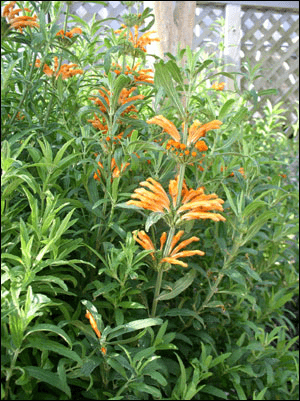
Lion’s ear is a colorful but underutilized perennial that produces clusters of fuzzy orange flowers beginning in late summer or early fall.
Characteristics
Lion’s ear (Leonotis leonurus) is a semi-woody perennial that belongs to the mint family and is native to southern Africa where it grows in rocky grasslands.
Gardeners love this Florida-Friendly plant for its brightly colored, tubular flowers that appear along the stems in late summer or early fall and attract honeybees, butterflies and hummingbirds. In South Florida, lion’s ear will continue blooming throughout the winter months and into spring.
When grown under optimal conditions, lion’s ear can reach five feet tall and four feet wide.
Planting and Care
Lion’s ear can be grown in zones 8-11. In zones 8 and 9 it may freeze to the ground in winter but will usually come back strong in the spring.
This drought-tolerant plant needs a well-drained soil; overly wet conditions can kill the plant. Lion’s ear prefers a location in full sun, though it will also grow in part shade.
Gardeners who enjoy passalong plants will also like lion’s ear, since cuttings can be used to start new plants. It occasionally reseeds although not aggressively.
For more information on lion’s ear, contact your county Extension office.
An Invasive Lookalike
There is another plant, Leonotis nepetifolia, that is not recommended by IFAS and looks very similar to Florida-Friendly Leonotis leonurus, and to make matters even more difficult, it’s often called lion’s ear as well!
The UF/IFAS Assessment of Non-native Plants in Florida’s Natural Areas has found a high risk of invasion by L. nepetifolia. One of the simplest ways to tell the difference is in the leaves.

The leaves of our Florida-Friendly lion’s ear are lanceolate (pointed at both ends), longer and not as sharply serrated.

The leaves of the invasive Leonotis nepetifolia are cordate (heart-shaped), more serrated and larger.
