
Azaleas
Few other flowering shrubs put on such a spectacular show — some azaleas produce so many flowers at once that you can hardly see the leaves!
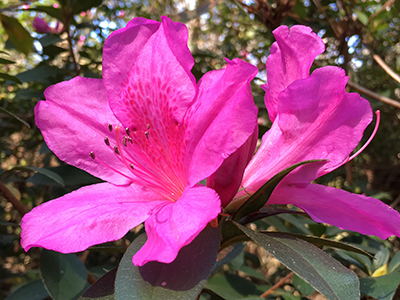
Azaleas are a classic Southern plant, both for the structure they provide year-round and for the magnificent floral displays they produce.
These lovely plants are best suited for North and Central Florida gardens and come in a number of shapes and sizes that can work within any garden. But South Florida gardeners need not feel left out — certain azalea relatives work great in tropical climates.
Common Evergreen Azaleas
Most of the evergreen azaleas growing in Florida home landscapes are hybrids, and originally came from Asia. Because evergreen azaleas hold their leaves year-round, they make great backdrop plants for seasonal flower beds. And of course in the spring, they put on their own show with flowers ranging in color from white, to pink, to red, depending on the cultivar.
One widely planted evergreen cultivar is ‘George Tabor’, a variety that produces countless soft pink flowers each spring and grows to about 10 feet tall and 8 feet wide. ‘George Tabor’ is classified as a “Southern Indica” hybrid, a type favored by gardeners for its vigor and tolerance of colder temperatures, typically down to 20°F without experiencing serious damage.
Other popular Southern Indica hybrids include, ‘Brilliant’ (carmine red flowers), ‘Formosa’ (brilliant rose-purple flowers) and ‘Mrs. G. G. Gerbing’ (white flowers). The ‘Little John’ cultivar is also popular, due to its unique burgundy foliage and deep red flowers.
“Satsuki” hybrids are mid-sized azaleas, typically growing the about 5 or 6 feet high within 10 or 15 years. They come in a range of colors from white to pink, yellowish pink, red, reddish orange and purple, often with patterning on the petals. Popular cultivars include ‘Flame Creeper’ (orange-red flowers) and ‘Gumpo’ (white or pink flowers).
For smaller-scale plantings, “Kurume” hybrids can be a good choice, since they grow from 3 to 5 feet tall depending on the variety. Kurume hybrids produce pink, red, purple or white flowers that are smaller in size than those of the Southern Indica hybrids but no less plentiful.
True dwarf varieties are also available, including the popular ‘Red Ruffle’ cultivar, which grows 2 to 3 feet tall.
Deciduous Hybrids
Cultivated varieties of deciduous azaleas include the “Aromi” hybrids, which were bred to perform well in the heat and humidity of the coastal South. These azaleas may reach up to 12 or 15 feet tall, depending on conditions. Popular selections include ‘Aromi Sunrise’ (orange-red buds opening to light orange with dark orange center), ‘Centerpiece’ (white flowers with yellow spots) and ‘Sunstruck’ (pale yellow buds opening to lemon yellow with darker patches).
Native Azaleas
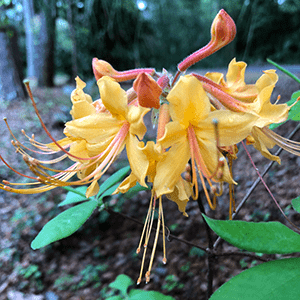
Uncommon in landscaped home gardens, native azaleas have smaller flowers and are more delicate-looking, but they’re also very fragrant. Non-native azaleas have no fragrance. Native azaleas bloom around the same time as other azaleas, in the spring, with colors just as spectacular, ranging from pink to peach to yellow.
Florida has just one native azalea that is evergreen — Chapman’s azalea (Rhododendron chapmanii). Listed as rare and endangered, Chapman’s azalea grows in sandhills, scrubby flatwoods and bogs. It’s only been found wild in four counties, mostly in the Panhandle. When not in bloom, its loose growth habit blends into the surrounding brush. In spring, pink flowers appear in showy clusters at tips of branches.
Most native azaleas are deciduous, losing their leaves in the winter and will slowly grow up to 10 feet tall. Like other azaleas, they prefer a well-drained, acidic soil and filtered sunlight. Native azaleas are drought tolerant and need little maintenance other than occasional pruning to maintain a healthy shape.

Many natives are growing in popularity and becoming more available, like the Florida flame azalea (R. austrinum). This drought-tolerant azalea produces flowers that may range in color from white or pale yellow to orange-red flowers. It will grow up to 8 or 10 feet tall and has a looser growth habit than many of the commonly grown non-native cultivars.
Another azalea native to Florida is Rhododendron canescens. It goes by a number of common names, including pink pinxter azalea and Florida honeysuckle. This shrub can grow between 6 and 15 feet tall and produces fragrant, showy pink flowers in early spring, typically when the leaves first appear.
Pruning Azaleas

Azaleas are widely planted in Florida because of the colorful flowers they produce from late February to early April. Pruning your azaleas can improve their blooming and help them develop into full, well-branched shrubs.
Always prune your plants in late spring or early summer, shortly after flowering, because azaleas set their flower buds for next year during the summer. Prune too late and chances increase that you will remove flower buds.
Several light prunings early in the growing season will help your azalea develop the nicest form. Remove shaded-out branches first, since these often become dead wood.
Older plants may have tall leggy branches that need to be removed. Doing so gradually over several years reduces shock to the plant.
Azalea Alternatives for South Florida

Although azaleas aren’t well suited for South Florida, gardeners in the tropical regions of the state can try growing an azalea relative called the vireya rhododendron. These plants are technically a sub-species of the genus Rhododendron and are native to tropical areas in Southeast Asia. In the wild, the majority of vireyas are found growing either as epiphytes, clinging to branches and trunks high in the tree canopy, or in rocky crevices in steep, sloping areas.
Vireyas are small plants that can be grown in hanging baskets or beds and borders. Easy to care for, their basic requirements are a frost-free growing environment and well-draining soil. There are more than 300 species of vireya rhododendrons, with flowers in an array of shapes and colors, often scented. Several species have distinctive foliage with a unique, scaly covering.
For more information on azaleas, contact your county Extension office.
Also on Gardening Solutions
More from UF/IFAS
- Key Plant, Key Pests: Azalea (Rhododendron spp.)–Ask IFAS
- Rhododendron canescens Pink Pinxter Azalea, Florida Honeysuckle–Ask IFAS
- Rhododendron chapmanii, Chapman’s Azalea–Florida Natural Areas Inventory (PDF)
- Rhododendron x ‘Fashion’, Fashion Azalea–Ask IFAS
- Rhododendron x ‘George Taber’, George Taber Azalea–Ask IFAS