
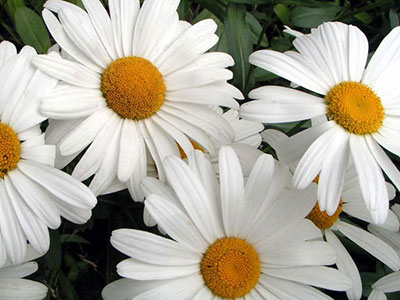
Shasta Daisy
Daisies are charming, friendly flowers, and the Shasta daisy is no exception.

Ideal as bedding plants, with attractive foliage that stays green year-round, Shasta daisies have a wildflower look and are a good choice for container gardens, cut-flower plantings and butterfly gardens.
Developed by the American horticulturist Luther Burbank in 1901, this hybrid daisy is named for California’s snow-topped Mount Shasta. They’re part of the enormous Asteraceae family of flowering plants, along with sunflowers, zinnias, marigolds and more.
Shasta daisy flowers are about three inches across. Like most aster species, Shasta daisies have composite flowers. The distinctive yellow center is made up of hundreds of tiny disk flowers, and the familiar white petals around the edges are actually ray flowers. The daisies appear in early summer, and you can extend the blooming period by removing the old blooms. The leaves are narrow, serrated and dark green.
While the Shasta daisy is a perennial that can be grown throughout the state, it’s treated as an annual in Central and South Florida, where the high summer temperatures kill this cold-hardy flower off.
Shasta daisies come in many cultivars and flower forms. One popular cultivar is ‘Becky’, which grows larger than other Shasta daisies and is resistant to fungal rot and leaf spot. Other cultivars, like ‘Real Glory’ and ‘Crazy Daisy’, have frilly, ribbon-like petals.
Typically available as transplants, plant your Shasta daisies in well-drained soil in full sun to partial shade. Avoid overwatering as these plants are prone to fungal disease and need to stay relatively dry. The daisies can grow up to several feet tall on their sturdy stems. Deadhead regularly; removing spent blooms not only encourages flowering but also keeps self-seeding in check.

