
Growing Mushrooms at Home
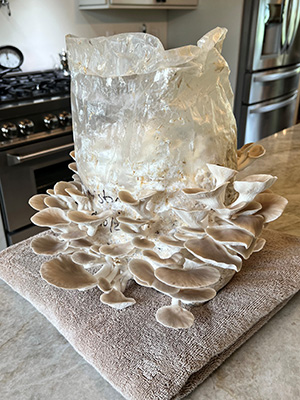
For mushroom lovers, the idea of growing these fabulous fungi at home can be exciting—and intimidating. Oyster mushrooms (Pleurotus ostreatus) or shiitake mushrooms (Lentinula edodes) are great choices for first-time home growers because they are delicious and some of the easiest to grow. Shiitake mushrooms, while often found in stores, are much cheaper to grow at home. Oyster mushrooms are less common in stores because of their delicate nature, making them difficult to transport.
Purchasing a mushroom cultivation kit is the easiest way to start growing your own mushrooms at home. How you grow your mushrooms will depend on the kit you buy. But don’t worry; they should come with instructions to help you get started.
A Little About Mushrooms
The parts of the mushrooms that we eat are the fruiting (reproductive) bodies of fungi. Growing mushrooms is quite different from growing plants. Since mushrooms are not capable of photosynthesis and producing their own food like plants, mushrooms depend on a substrate, or material on which the mushrooms grow. Logs, straw or other cellulose sources are some examples. The mushrooms take nutrients from the substrate as it decomposes. Growing mushrooms indoors is generally preferred since it will provide you with more continuous and predictable fruiting. You can also grow them outside under a shade house.
Oyster Mushrooms
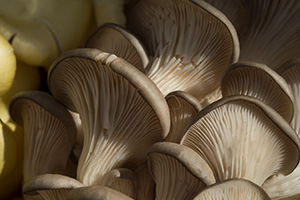
Named for their resemblance to the shellfish, oyster mushrooms are delicate, with a subtle flavor that is milder than shiitakes. Colors will vary with different strains, so you might have tan, cream, grey, pink or yellow mushrooms.
They are easy to prepare in the kitchen and work well in stir fries and soups or just sautéed with garlic. Oyster mushrooms are an excellent source of fiber, protein and many vitamins and minerals. These interesting fungi taste best when harvested young, as they are more tender and mild.
Generally, oyster-mushroom growing kits will come with a mass of sticky white mycelium (the thread-like, non-reproductive starter part of mushrooms) that has colonized a tower of straw inside a perforated plastic bag. After soaking the bag, mushrooms will form on the outside and should be ready for harvest in about a week to 10 days.
If you are brave and wish to purchase spawn (the part of the mushroom that facilitates the establishment of mycelium) and prep your own substrate without the ease of a kit, you can reference the Ask IFAS publication “D.I.Y FunGuide: Grow Your Own Oyster Mushrooms at Home.” Keep in mind that certain species of oyster mushroom are invasive, like the golden oyster mushroom (Pleurotus citrinopileatus), so be mindful when choosing your spawn or kit.
Shiitake Mushrooms
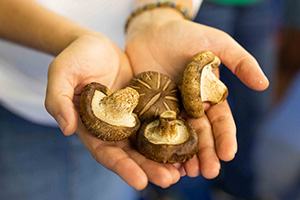
Shiitake mushrooms have a full, smoky flavor and a dense texture that holds up well for cooking. They can be used in lieu of meat in a dish or simmered in broth, wine reduction or cream sauce. Shiitakes are also packed with nutrition, providing significant fiber and protein.
To begin, you can choose either a “mushroom block” or a hardwood log as the substrate. A mushroom block is comprised of lignum (i.e. hardwood) and cellulose (i.e. soy hulls). These blocks can come as a kit with instructions and the supplies you need. They can even be “pre-inoculated,” meaning the spawn have already been inserted into the block.
If you go with a hardwood log as substrate, oak logs are the best choice for Florida, but sweetgum, red maple and poplar can also be used. Freshly cut logs are required because older logs may already be inhabited by naturally occurring mushrooms. The logs can be cut from the trees when they are dormant (December to early February). The logs should be a diameter of 2 to 7 inches and a length of 3 to 4 feet.
You will need to inoculate the log yourself. First, purchase the shiitake spawn. For ease of use, we recommend getting the “plug” form, which contains the spawn in a capsule. Make sure you get strains that match well with our Florida climate. A list of supply dealers can be found at North American Mycological Society webpage. You can also check with your local mushroom producer to see if they sell spawn kits. Or they might be able to provide tips on where to get one and which types are the best.
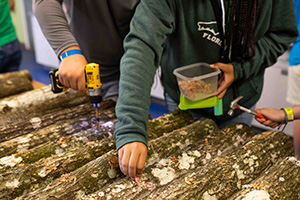
The next step is to inoculate the wood by drilling holes in the logs and inserting the spawn with a plunger, hammer or turkey baster. The holes need to be sealed with hot wax to protect the spawn from drying out or becoming contaminated. The logs need to undergo “incubation” by sitting in a cool (50-70°F), moist, aerated area, giving the mycelia time to colonize the log and absorb nutrients. There are a few heat-tolerant strains if you are looking to grow them outdoors; just make sure to place them in the shade. The log will rot if it remains too wet, so only irrigate if it starts to dry out. The fungi should begin producing mushrooms in six to 18 months.
Inoculated logs can produce shiitake mushrooms for 3-5 years. The fungi will produce mushrooms for about a week, then take a rest period of generally two to four months (sometimes less) before fruiting again.
Mushrooms are an excellent food for producing at home and can be a very rewarding process. Once you get the hang of mushroom growing, you may even want to try a more challenging mushroom like reishi (Ganoderma lucidum). For more information on growing your own mushrooms, contact your county Extension Office.
Also on Gardening Solutions
More from UF/IFAS
- DIY FunGuide: Grow Your Own Oyster Mushrooms at Home
- Gardening in the Panhandle: Grow Shiitake Mushrooms in Your Backyard
- Gardening in the Panhandle: Oyster Mushrooms Can be Grown at Home
- Isolation of Mother Cultures and Preparation of Spawn for Oyster Mushroom Cultivation
- Mushroom—Agaricus bisporus (Lge.) Sing. (Archived on EDIS Journal)
- The Pecan Truffle (Tuber lyonii): A Gourmet Truffle Native to the Southeastern US
Elsewhere on the Web
Oregon State University Extension Service has an informative publication on growing reishi mushrooms (PDF).