
Longan
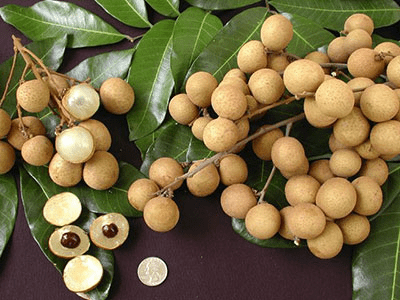
A relative of the lychee, longan fruit is extremely sweet and juicy and grows in clusters.
Native to Asia, longan was introduced here in the early 1900s and is grown in Hawaii, California, and South Florida. There are numerous cultivars of longan; ‘Kohala’ is the variety most planted in Florida.
Longans are evergreen trees with dense, dark green foliage and corky bark. Trees typically grow to 30-40 feet. The fruit are round, with a smooth, light brown peel and translucent pulp. There’s a single, shiny brown seed in the center.
Longans bloom in South Florida from February or March through early May, and fruit harvest season is from the middle of July to early September, peaking in August.
Planting and Care
Longans are subtropical trees and adapted to tropical climates. They thrive in sandy, well-drained soil. In general, longan trees should be planted in full sun for best growth and fruit production. Select a part of the landscape away from other trees, buildings, and powerlines; remember, longan trees can become very large.
After planting, irrigate regularly to establish. Once trees begin to bear (3 to 4 years after planting), water regularly only in spring and summer, when they’re flowering and bearing fruit. Longan trees experience few disease problems, but common pests include the lychee webworm and several scale insects. Please contact your local Extension office for current control recommendations.
Fruit is ready to harvest around August. The peel will be a deep tan, but the best ripeness indicator is pulp sweetness. Once removed from the tree, the fruit will not ripen further. Harvested fruit should be cooled as soon as possible. Longan fruit have a relatively short shelf life; place your harvest in a plastic bag and it should keep in the refrigerator for 5 to 7 days.
UF/IFAS Publications
Adapted and excerpted from: J. H. Crane, C. F. Balerdi, S. A. Sargent, and I. Maguire, “Longan Growing in the Florida Home Landscape” (HS49), UF/IFAS Horticultural Sciences Department.