
Cloudless Sulphur Butterfly
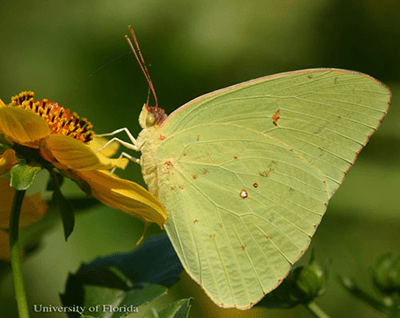
Those pretty little patches of yellow that you often see flitting about your garden are cloudless sulphur butterflies, one of Florida’s most common butterfly species.
This butterfly gets its scientific name, Phoebis sennae, from Phoebe, sister of the sun god Apollo in Greek and Roman mythology, and Senna, the genus to which many of the cloudless sulphur’s larval host plants belong.
Adult butterflies are usually bright yellow, although females can sometimes be pale yellow or even white. Cloudless sulphur butterflies have relatively long tongues and are able to reach the nectar in tubular flowers that other butterflies cannot. They prefer red flowers and frequently get nectar from red morning-glory (Ipomoea coccinea), scarlet creeper (Ipomoea hederifolia), cypressvine (Ipomoea quamoclit), and scarlet sage (Salvia coccinea). Fun fact: the males sometimes drink from mud.
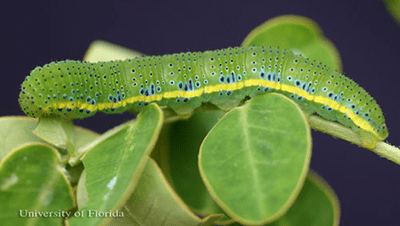
Generally, the larvae of these butterflies are green with yellow lateral lines, blue patches, and bands of tiny blue spots bearing black setae (short hairs covering all or a part of their bodies). But the caterpillars can look different depending on what they eat. Larvae that feed predominantly on flowers instead of leaves are yellow with black bands.
There are a number of native and non-native host plants for cloudless sulphur caterpillars.
Native Host Plants
- Florida Keys sensitive pea, Chamaecrista deeringiana
- Maryland wild sensitive plant, Senna marilandica
- narrowpod sensitive pea, Chamaecrista lineata var. keyensis
- partridge pea, Chamaecrista fasciculata
- privet wild sensitive plant, Senna ligustrina
- sensitive pea, Chamaecrista nictitans
- Chapman’s wild sensitive plant, Senna mexicana var. chapmanii
- coffeeweed (sicklepod), Senna obtusifolia
Introduced Host Species
- Africa senna (popcorn senna or wild sensitive plant), Senna didymobotrya
- candlestick plant, Senna alata (the IFAS Assessment says this plant should be used with caution in North, Central, and South Florida; this means that plants should be managed to prevent escape)
- glossy shower, Senna surattentis
- septicweed, Senna occidentalis (the IFAS Assessment says this plant should be used with caution in North, Central, and South Florida; this means that plants should be managed to prevent escape)
- Christmas senna (Christmas cassia or valamuerto), Senna pendula var. glabrata (the IFAS Assessment says this plant is invasive and should not be planted in South Florida; be aware that this plant is also often sold under the incorrect name Senna bicapsularis)