
Cogongrass
Beware this federally prohibited plant masquerading as an “ornamental grass”


Listed as one of the world’s ten worst weeds, cogongrass is an invasive perennial grass. In Florida alone, it has spread to more than a million acres. Cogongrass usually invades open areas like golf courses, roadsides, pastures and natural areas where it displaces native plant species. It costs millions each year to control in Florida¹. And yet you might see it offered for sale in a garden center.
Why is cogongrass a problem?
Native to Southeast Asia, cogongrass (Imperata cylindrica) forms dense patches that can displace native vegetation, reduce biodiversity and alter ecosystems. When it takes over in pastures, sometimes it becomes the only plant species in the area.
It’s as bad for people, too. Researchers at UF’s Invasion Science Institute (ISI) found that lone star ticks survive more than 50% longer in areas dominated by invasive cogongrass than in native plant communities. Lone star ticks can transmit a range of disease-causing pathogens and are linked to alpha-gal syndrome, a potentially life-changing allergy to red meat and some dairy products.
Cogongrass is highly flammable and regenerates after fire. Research from UF shows that cogongrass is a significant fire risk, allowing wildfire to spread faster and burn with longer flames that can reach the tree canopy, causing even more damage.
How to recognize cogongrass
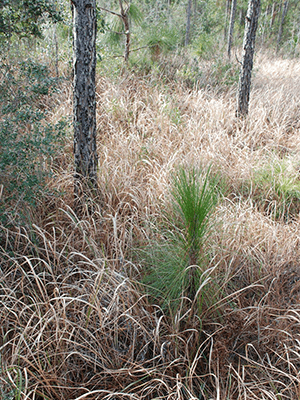
Floridians should recognize cogongrass in case it pops up on their own property. It grows in bunches that can reach six feet tall. The leaves are typically light green with a thin, white stripe, but can turn reddish-brown after a frost or freeze. In spring or summer, the plants produce fluffy white seed heads.
Cogongrass spreads not only by seed, but also through its extensive underground root system, making it particularly difficult to contain. Small pieces of its roots can establish new plants, and soil disturbance from plowing or construction can create opportunities for the grass to become established.

Cultivars of cogongrass are sometimes sold as Red Baron or Japanese bloodgrass for the striking red tips. While these cultivars were selected to be sterile, the plants still spread rapidly by rhizomes and can even revert back to the aggressive form.
Residents can use citizen science resources such as iNaturalist and EDDMapS to report instances of cogongrass or to see where the invasive grass has been reported in their area. For more information about cogongrass and other invasive plants, contact your county Extension office.
Also on Gardening Solutions
More from UF/IFAS
- Avoid Invasive Plants Available in the Market–UF/IFAS Blogs Alachua County
- Can invasive plants increase tick exposure risk? Scientists reveal a surprising link to human health–UF/IFAS News
- Imperata cylindrica: Cogongrass–UF/IFAS Assessment of Non-native Plants in Florida’s Natural Areas
- Invasive Plant Guide for Homeowners in Florida: Cogongrass–UF/IFAS Center for Aquatic and Invasive Plants (PDF)
- What is helping some Florida wildfires burn hotter, spread faster? UF/IFAS News
- Weekly “What is It?” Cogongrass–UF/IFAS Blogs Escambia County
1. “An economic input/output analysis revealed that cogongrass control costs resulted in total economic losses of $35 million annually to the forestry industry and related business sectors throughout Florida.” Divate, Nandkumar & Solis, Daniel & Thomas, Michael & Alvarez, Sergio & Harding, David. (2017). An Economic Analysis of the Impact of Cogongrass among Nonindustrial Private Forest Landowners in Florida. Forest Science. 63. 201–208. 10.5849/forsci.16-079.