
Beneficial Insects
Beneficial insects are an important part of pest management in your Florida-Friendly landscape.

Insects sometimes get a bad reputation, but of the millions of insects worldwide, less than 1% are considered pests1. In fact, most are beneficial to the landscape and people, and even perform functions that foster healthy plants.
These beneficial insects prey on pest species, pollinate plants and recycle nutrients by breaking down dead plant material. Their presence can reduce the need for pesticides and serve as a vital component of integrative pest management (IPM).
You can attract beneficial insects to your garden by planting many different species of plants. Trees and shrubs provide food and shelter with their foliage while flowers provide pollen and nectar, which most beneficial insects eat at some point in their lifecycle. Plants of varying heights and blooming periods will attract a wide range of beneficials.
Native flowers are excellent attractants, including coreopsis, beach sunflower, coneflower, dotted horsemint and bee balm. Good options for shrubs include Walter’s viburnum, yaupon holly, saw palmetto and gallberry. Certain herbs and sunflowers can bring in the good bugs as well. Clumping grasses provide cover for beetles and other insects and serve as place for many pollinators to lay their eggs in.
You can even appeal to beneficial insects using “banker plants.” Banker plants attract beneficial insects into the garden to help mitigate plant-pest insects. As the beneficials feed on nectar and pollen from these banker plants, they will also provide free pest control by feeding on plant pest insects.
So who are these beneficial insects? Some particularly helpful ones are listed below, but keep in mind there are many more.
Dragonfly
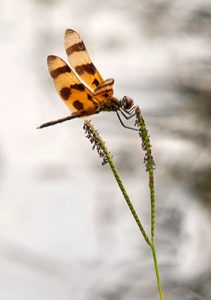
There are over 100 species of dragonflies found in Florida. They are speedy predators, flying up to 30 miles per hour! This allows them to capture their food while flying. They are even nicknamed “mosquito hawks” for hunting mosquitoes in the air. These fast flyers also feed on flies, thrips, midges and gnats. Dragonflies lay their eggs in mud or water, where the nymphs will hatch and live in the water for up to two years, consuming mosquito larvae.
Lacewing
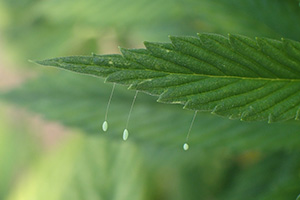
In the larval form, green lacewings are beneficial predators of aphids, scale insects, whiteflies, thrips and other pests. They don’t bite or sting and are quite proficient hunters. They are common in Florida, with 22 species found in the state. Brown lacewings are less commonly seen, and feed on soft-bodied insects like aphids and mealybugs, as well as insect eggs.
Female lacewings will often lay their eggs near an aphid colony or other food source. Once hatched, the larvae will voraciously feed on the pests. Lacewing larvae resemble small caterpillars, but move more quickly and have longer legs and mouthparts. Adult lacewings feed on insects, nectar, pollen or honeydew (a secretion that comes from aphids and some scale insects). They are less than an inch long and light green, with two pairs of wings.
Assassin Bugs
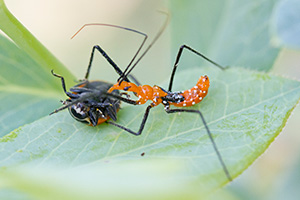
Assassin bugs are aggressive predators of invertebrate prey in the garden such as mosquitoes, flies, cucumber beetles and caterpillars. One of the most common species in Florida is the milkweed assassin bug (Zelus longpipes). It ranges from orange-brown to black and has a curved beak that is used to inject venom into its soft-bodied prey. The injection dissolves the host’s tissues, killing it from the inside out. An assassin bug can attack prey that is up to six times its size.
Spiders
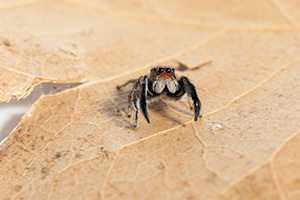
Spiders are technically arachnids, not insects, but they are equally beneficial in the landscape. While these creepy crawlers might startle you, most do not cause harm to humans. They feed on a variety of pest insects, depending on the species, including beetles, caterpillars, aphids, flies, mosquitoes and roaches. An example of a predatory Florida spider is the jumping spider, which hunts by pouncing on its victims. The golden silk spider, commonly known as the banana spider, feeds primarily on flying insects, which it catches in its web. The green lynx spider, often encountered in shrubs, leaves and foliage, does not spin webs but instead anchors itself with silk.
Parasitic Wasps
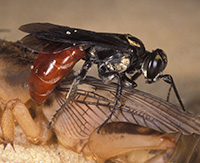
Parasitic wasps are tiny, solitary insects and generally not dangerous to humans. These inconspicuous creatures play an important role in keeping pest species in check, for they are natural enemies of caterpillars, grubs, scales, whiteflies and aphids. These wasps are “parasitoids,” meaning they deposit their eggs on or in a host insect. After hatching, the wasp larvae will consume the host, often from the inside out. Sometimes the larvae live in cocoons attached to the outside of the host. Adult wasps reach less than 1/8-inch long and usually travel about the garden unnoticed.
Ladybugs
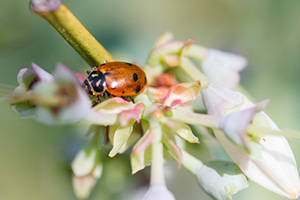
Ladybugs, also called lady beetles, have an appetite for soft-bodied insects like scales, aphids, mealybugs, whiteflies and mites. The adults are oval-shaped, and most are orange/reddish with black markings, reaching a length of ¼ inch. The larvae are often mistaken for mealy bugs, a pest insect. They are darkly colored, flattened and covered in spines, with bright colored spots or bands. During the larval stage, a single individual can consume up to 500 aphids. There are over 100 species of ladybugs in Florida.
Praying Mantis
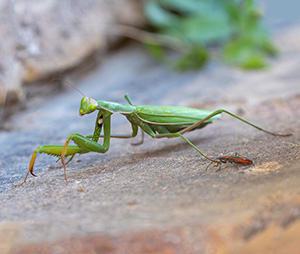
Praying mantises are famous for their large eyes and alien-like head that can swivel 180 degrees. When waiting to pounce on their next meal, they keep their long, grasping forelegs raised as if in prayer. These stealthy predators are excellent at pest control, but keep in mind that they also eat beneficial insects, and in some cases, hummingbirds! They prey regularly on aphids, grasshoppers, caterpillars and cockroaches. Praying mantises also keep ecosystems in balance by serving as food for wildlife like birds and frogs.
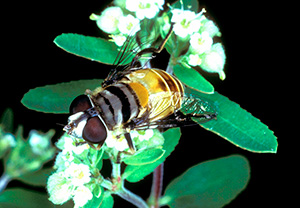
Other beneficial insects include pollinators like bees, moths and butterflies. The cloudless sulphur, giant swallowtail, and monarch butterflies are some common species. Additional helpful predators include big-eyed bugs, earwigs, syrphid flies and tachinid flies.
Remember that many pesticides kill not only pest insects but also beneficials. If you do use a pesticide, choose one that targets only the pests you’re having trouble with.
By acknowledging the value of insects and supporting them, you can have a healthier and more sustainable landscape. For more information about attracting beneficial insects to your garden, reach out to your UF/IFAS county Extension office.
Resources
- Redak, R. (2023). Introduction to and importance of insects. In: D. Allison, J., Paine, T.D., Slippers, B., Wingfield, M.J. (eds) Forest Entomology and Pathology. Springer, Cham. https://doi.org/10.1007/978-3-031-11553-0_
Also on Gardening Solutions
More from UF/IFAS
- Beneficial Insects–UF/IFAS Extension Sarasota County
- Bigeyed Bugs, Geocoris spp.
- Brazilian Red-Eyed Fly Ormia depleta
- Brown Lacewings of Florida–Ask IFAS
- The Good Guys: Beneficial Insects in Your Garden–Gardening in the Panhandle
- Green Lacewings of Florida–Ask IFAS
- Invertebrates as Biological Control Agents of Agricultural Pests–Ask IFAS
- Ladybirds, Ladybird beetles, Lady Beetles: Ladybugs of Florida–Ask IFAS
- Milkweed Assassin Bug–Ask IFAS
- The Spooky Bug Brigade: Earwigs–UF/IFAS Blogs Sarasota County
- Syrphid Flies, Hover Flies–UF/IFAS Entomology and Nematology
- Using Insectary Plants to Attract Pest Predators–UF/IFAS Blogs Orange County
- What is a Praying Mantis? UF/IFAS Entomology and Nematology