
Pollinator Hotels

While some may run for the hills when anything with a stinger flies by, gardeners know that it might be a helpful pollinator. Having pollinators like bees and wasps set up their home right in your garden can be great for your plants, and are often quite harmless when left alone. And while you can’t tell a bee where to nest, you can provide pollinators with an ideal structure should they decide to move in — a pollinator hotel.
Your Resident Pollinators
Solitary bees and wasps are likely to take up residence in your pollinator hotel not long after you place it outside. While honey bees get most of the pollination buzz, solitary bees and wasps do a lot of the work in the garden, and some even take care of pests too.
Some of the bees you might find in your hotel include leafcutter bees, carpenter bees and orchard mason bees. These solitary species are not aggressive and don’t typically bother humans. You may notice the work of leafcutter bees in your garden; they cut circular sections out of a plant’s leaves and then use the pieces to build nests.
Solitary wasps may also be attracted to your pollinator hotel. As with solitary bees, these wasps are generally less aggressive than their group-dwelling counterparts. Potter wasps and red and black mason wasps are some of the common wasp residents of pollinator hotels. While people may be wary, these flying pollinators are far more likely to lend a hand in the garden than sting. And many solitary wasp species are predators that will help keep hungry caterpillars in check.
Building Your Hotel
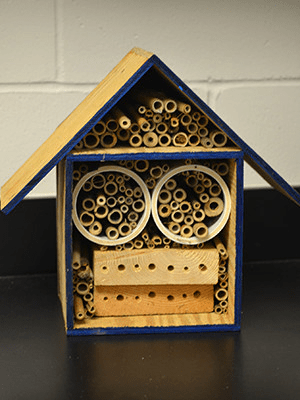
There are many ways to create a great little hotel for native pollinators. You can create your hotel with some affordable supplies, some of which you may already have around your house.
Bundling the hollow stems of bamboo together is an easy way to make a pollinator hotel. You can fill any number of containers you might have around your house with bamboo: a plastic tumbler, ceramic flower pot or an old coffee can. Be sure the bamboo pieces are sealed at the back end. Some types of bamboo have nodes that close off sections to form their own seals, or you can seal off the cut of bamboo yourself. Be sure to vary the lengths of bamboo. Bees are visual navigators and it will help them remember which bamboo piece is home if the rods aren’t all identical.
Another way to make a nesting area for native bees is to take a piece of wood and drill holes into it. Use drill bits of various sizes (between 1/8 inch and 1/2 inch) and drill to various depths (between 3 and 8 inches). Make sure your holes don’t go all the way through the wood. It’s best to use smaller pieces of wood for your pollinator hotel so that they are easy to change out regularly.
In fact, any hotel materials should be changed out every two to three years to help prevent the spread of parasites and disease. With single pieces of bamboo this is pretty easy to do; simply discard used pieces — after checking to be sure they aren’t currently inhabited, of course.
When it’s time to freshen the hotel with new “rooms,” multiple, smaller pieces wood will be easier to keep track of inhabitants. As you monitor your hotel, see which holes bees and wasps seem to be using. As you notice a hole going unused, seal that hole off. Continuing sealing up uninhabited holes until there are no open “rooms” in the block. You can also gently encourage your bees to go nest elsewhere (more on that below).

Remember that bees use visual cues to navigate and find their way back to their nesting site. To help with navigation you can paint simple designs in different colors on your hotel. And keep the structure small; it’s much easier for a bee to find their way back to their room when it’s one of fifty and not five hundred.
It’s also a good idea to build some sort of a roof over your hotel to help protect it from the elements. This can be as simple as affixing a piece of wood to the top with a slight overhang.
Place your hotel in an area where it will get some sunlight and shade, with protection from the elements. The “V” of a tree or the windowsill of a window facing east or south are ideal locations.
Within just a few weeks you may see pollinators starting to nest in your little hotel.
Remember, if you are building a pollinator hotel it’s best to stop using insecticides in the area or be very selective of the types of insecticides used and when you apply them. It’s a poor innkeeper that poisons his guests!
For more information on attracting pollinators to your landscape as permanent residents, contact your county Extension office.
Our thanks to the UF/IFAS Honey Bee Research and Extension Lab for guidance on this article.
Also on Gardening Solutions
More from UF/IFAS
- Attracting Native Bees to Your Florida Landscape
- Blue Orchard Bee, Osmia lignaria Say
- Leafcutter Bees, Megachilidae
- Potter Wasps of Florida, Eumenes spp.
- Red and Black Mason Wasp (suggested common name) Pachodynerus erynnis
Sidebar: Encouraging your pollinator residents to leave an old hotel

Hotels should be changed out every two to three years to help prevent the spread of parasites and disease. With a single wooden structure, you may have to gently encourage your guests to leave. The easiest way to do this is by covering the structure with a completely dark container. On the underside of the container drill a hole large enough for a bee to exit through. Leave the box on a flat surface with the hole hanging over the edge.
Your resident pollinator will fly down towards the light and out of the box leaving you free to discard the nesting block and replace it with a fresh new one. This method works because bees and wasps will not fly up into a hole on the underside of a box to reinter the nesting area.