
Coontie
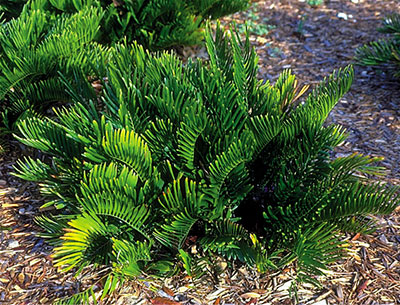
Like all cycads, the coontie has ancient origins. But this Florida plant is the only cycad native to the United States. It’s also the preferred food source for larvae of the rare Atala butterfly.
The coontie (Zamia integrifolia) has a mounded form and is typically 2 to 3 feet tall. It has stiff, glossy, featherlike leaves attached to a thick, short, underground stem. Florida’s native peoples once ground up the underground stems to create a starchy “flour” for cooking. Don’t try this yourself, though — the stem is toxic unless prepared properly.
Coonties can be used as a specimen plant or in foundation and massed plantings, placed 3 to 5 feet apart.
Coontie can be planted year-round throughout Florida, from zones 8b-11. Because of its high drought tolerance and moderate salt tolerance, the coontie is an excellent choice for the coastal landscape. And it’s cold hardy, too.
The coontie grows best in some shade, but can tolerate full sun or shade. It grows in most soil types and once established, rarely needs water.
Coonties and the Atala Butterfly

Historically growing wild in the pine rocklands of South Florida, coontie plants established expanding clusters near each other.
This growth habit was ideal for the atala butterfly, because females didn’t have to fly far to find their host plant and the caterpillars had a close source of foliage on which to feed. Heavily concentrated in tender new coontie growth favored by the atala larvae is the toxin cycasin.
As caterpillars devour the coontie foliage (and we do mean devour; they can completely defoliate a plant), they absorb the cycasin. The toxin stays in their system and passed on the emerging butterflies, protecting the insects from potential predators. The eggs those butterflies produce will also contain the protective cycasin.
With recent introductions of non-native cycads for home landscapes, atala butterflies have laid eggs and hatched caterpillars on the other cycads, but research has found that the larvae survive better and live longer on native coontie. In an experiment, given a choice between a coontie and a non-native Zamia species, both butterflies and caterpillars overwhelmingly chose the native coontie.
About those hungry caterpillars: while atala caterpillars can take a coontie down to the roots, a healthy, established plant will recover by next season. But remind yourself that you’re fostering future rare atala butterflies!
For questions on butterfly gardening, coonties and other native plants for your landscape, contact your county Extension office.
A note on names: There is some disagreement on the “correct” botanical name. While you might see references to Zamia pumila, and some older UF/IFAS publications use Zamia floridana, the Atlas of Florida Plants uses Zamia integrifolia. We generally try to follow the Atlas, since this is the most comprehensive and accessible source on plants that are native or naturalized in Florida.