
Pruning Palms
Palms are iconic in Florida and highly valued for their aesthetics in the landscape.

You might feel inclined to prune your palms, however it’s important to understand why and how to prune. The type of palm and its relative health both factor into UF/IFAS pruning recommendations.
It is natural for palm fronds to experience a regular turnover as lower fronds die and are replaced by newer fronds at the apex of the tree. The dead fronds do not damage the tree or threaten its health.
Some palms have a “crownshaft,” which is a non-woody region extending 3 to 5 feet at the top of the tree below the fronds where tightly overlapping leaves form a smooth surface on the trunk. These types of palms regularly drop their older fronds, essentially self-pruning, about once a month. In these cases, there is no need to prune. This includes royal palm, foxtail and Christmas palm.
In other cases, dead foliage will hang loosely against the trunk of the tree. Some fronds will fall on their own, and others will stay attached. Homeowners can remove the dead and dying lower fronds to improve the appearance of the palm. Another reason to prune is to keep the dead fronds from falling and injuring people or property. Heavy fruit clusters can also fall off and create a mess or hazard. Removing dead palm fronds or fruit clusters can reduce these risks. When done properly, pruning of these parts of the palm is considered safe for the tree.
How to Prune
The number-one rule about pruning palms is to never remove live, green, healthy fronds. These leaves perform important functions, such as using photosynthesis to create food for the palm. Removal can also cause wounds in the crown that leave the tree vulnerable to disease.

If you have ever seen a palm that looks like a feather duster, with fronds pointing upwards but none to the sides, this is an over-pruned palm. It doesn’t provide shade and will be weaker than a full-canopied palm. If the practice is repeated, the palm can even develop smaller leaf sizes and a smaller trunk diameter. Imagine the palm canopy as a clock face. The absolute limit is to never prune past 9 o’clock and 3 o’clock. However, this is the limit, not the ideal pruning recommendation. You generally want a round, full canopy, with green leaves down to the bottom. A rule of thumb is to only remove fully brown fronds.
You may have heard of “hurricane pruning” or “hurricane-cut palms.” This practice is unfortunately common in Florida and harmful to palms. It is essentially the removal of most of the leaves with the intention of increasing wind resistance. However, this method is not rooted in science and actually makes trees less able to withstand hurricane-force winds. Observations in Florida after hurricane seasons have shown that hurricane-cut palms were more likely to have their crowns snapped off by the wind.
What to Prune
You may be tempted to remove half-dead or yellow leaves when pruning; however, it is not recommended. These fronds are possibly a result of nutrient deficiencies. If you remove these damaged leaves prematurely, it may cause a reduction in overall green, healthy leaves and erase evidence of symptoms that can be used to identify the problem. Note that some palms, such as Areca, have naturally yellowing older fronds that do not indicate a nutritional issue.
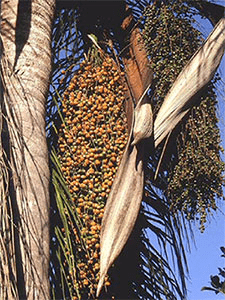
And even though they may look unsightly, these fronds often still provide some nutrients for the tree. Removal can also damage the crown and leave a wound that is susceptible to disease. Instead, only remove fronds that are completely dead. With that being said, there is no evidence that removing living flower or fruit stalks will cause harm to the palm.
There’s more about nutrient deficiencies and how to prevent, diagnose or treat them at our Palm Nutrition article.
When to Prune
In terms of timing, there is no one time that is better than others to prune. Commercial pruning is usually done on a fixed schedule, but you can prune your palms anytime that is convenient for you, as long as you follow the guidelines. However, if you would like to support local pollinators, wait until the blooms have dropped and fruit growth as begun before removing the fruit stalks.
Some final tips are to never use climbing spikes, as these can damage the tree. Never forcibly pull a frond off that does not come off easily, as this can leave an entry site for disease. Consider hiring a certified arborist, who is trained to prune palms for health.
Pruning palms is useful in the landscape for aesthetics and safety; just be sure to prioritize the health of the tree for longevity. If you have any additional questions about pruning your palm, reach out to your local UF/IFAS Extension office for more information.