
Agaves
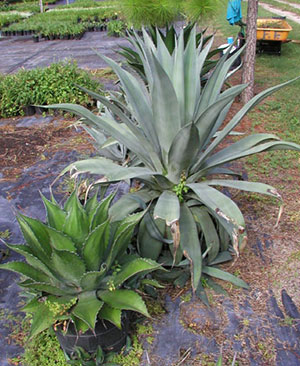
Found in both tropical and desert areas, agaves are tough succulents that include over 200 species. They grow native throughout the southwestern to southern-central United States to Venezuela, southern Florida to the Caribbean. As part of the Asparagaceae family, they are related to yucca, dracaena and yes, asparagus (along with hundreds of other plants).
Many people are familiar with one member of the genus, the century plant (Agave americana), but agaves are prized by collectors for the impressive range of sizes, unusual shapes and architectural growth patterns. This variety means they have many landscape uses, as groundcovers, container plants, shrubs and especially as dramatic specimens.
Agaves range in size from a few inches to up to 12 feet tall and wide. Their leaves can be deep green to blue-green to gray. Some are mottled or have stripes in yellow, cream or neon green. The flowers can be white, yellow or rose-colored.
A defining characteristic of all agaves is the large rosette of thick, fleshy leaves. The spear-shaped leaves can be up to 10 feet long, typically armed with teeth and tipped with a long spine.
They grow slowly and flower only once, typically after at least ten years. When the plant begins to flower, a tall stem grows from the center of the leaves, bearing a large number of short tubular flowers. After an agave blooms, it will die, but can be easily propagated from plantlets (often called “pups”) located at the base of the stem.
Most agaves need full sun and well-drained, sandy soils in order to thrive. Take care in choosing the right place for your agave, as their spines can be hazardous, especially around children. A rare exception is the fox tail agave (Agave attenuata), but it’s only suitable for the warmest parts of Florida (hardiness zones 10-11). The sap of many agave species can be irritating to skin, so wear gloves when handling and planting your agave.
Agaves are a good pick for Florida-Friendly landscapes. These plants tolerate even poor soil, as long as it’s well drained. This makes them excellent container plants for regions with cool weather where they must be brought in for the winter. Agaves need little to no water after establishment and many are salt-tolerant, too.
While agaves have few disease or pest problems, the agave snout weevil can be a serious pest, especially of larger agave species. The female weevil damages the plant when laying its eggs and the resulting grubs feed on the damaged plant tissue, causing it to wilt, collapse and eventually die. Infected plants should be destroyed. The other concern for agaves in humid Florida is root rot; these desert-dwelling plants need dry feet, so water sparingly.
Agaves have long been used by humans for fiber in baskets, cloth and rope, and perhaps more famously to make alcoholic beverages, including tequila. It should be noted that the process to make any edible food or alcohol from agave uses specific parts of the plant and is arduous and complicated. Most agaves are toxic if consumed without these specific processes. The sap may contain oxalate crystals that irritate the skin, mouth, tongue and throat.
There is one agave species native to Florida. Agave decipiens, commonly called false sisal, is only found growing wild in coastal southern Florida hammocks and uplands. It can grow up to 8 feet tall and has very sharp spines along its leaves.